Differentiable programming for plasma physics
Differentiable programming applies automatic differentiation to numerical solvers, turning any simulation into a component of a gradient-based optimization pipeline. In this review, we argue that this is not just a speedup trick but a unifying computational framework for plasma physics. We demonstrate this through four applications: discovering novel kinetic physics, learning fluid closures for kinetic effects, accelerating experimental Thomson-scattering diagnostics, and inverse-designing structured laser pulses. Each uses the same infrastructure — reverse-mode AD through a physics solver — but addresses a fundamentally different type of problem.
This paper is a preprint: Differentiable Programming for Plasma Physics: From Diagnostics to Discovery and Design.
A.S. Joglekar, A.G.R. Thomas, A.L. Milder, K.G. Miller, J.P. Palastro, and D.H. Froula, arXiv:2603.11231 (2026)
The framework: from manual iteration to function learning
The core idea is a progression in how computational physics is done. Traditional workflows are open-loop: pick parameters, run a simulation, analyze, repeat. Differentiable programming closes this loop by providing exact gradients of a scalar objective with respect to all inputs — at a cost that is independent of the number of parameters.
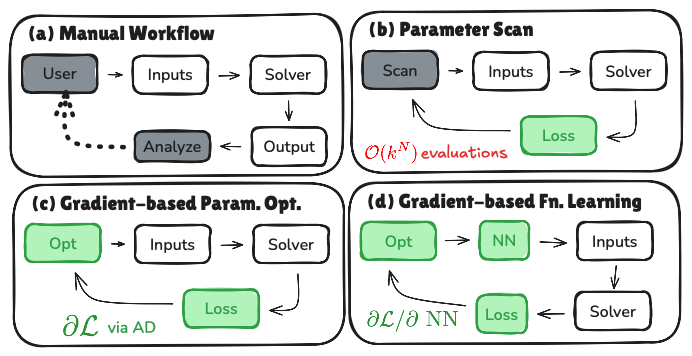
The key step is from (c) to (d). In stage (d), a neural network generates parameters for a physics solver. The chain rule propagates gradients through the network, the solver, and the objective — the network learns continuous functional relationships through the physics. No labeled training data is needed, only a physics-motivated cost function. The four applications in this paper span stages (c) and (d).
Where differentiable simulation fits
Differentiable simulation is distinct from surrogates, PINNs, and neural operators in a crucial way: the physics-based solver produces the solution, and any learned component merely generates parameters or closures for that solver. The governing equations — not a loss penalty or training distribution — enforce physical constraints. This has practical consequences for interpretability, conservation, and extrapolation that show up across all four applications.
Application 1: Discovering novel kinetic physics
We built a differentiable Vlasov-Poisson-Fokker-Planck solver and trained a neural network to learn optimal wavepacket excitation strategies by maximizing electrostatic energy and non-Maxwellian-ness. The optimization discovered a previously unknown superadditive regime: two interacting wavepackets sustain electrostatic energy far longer than either would alone.
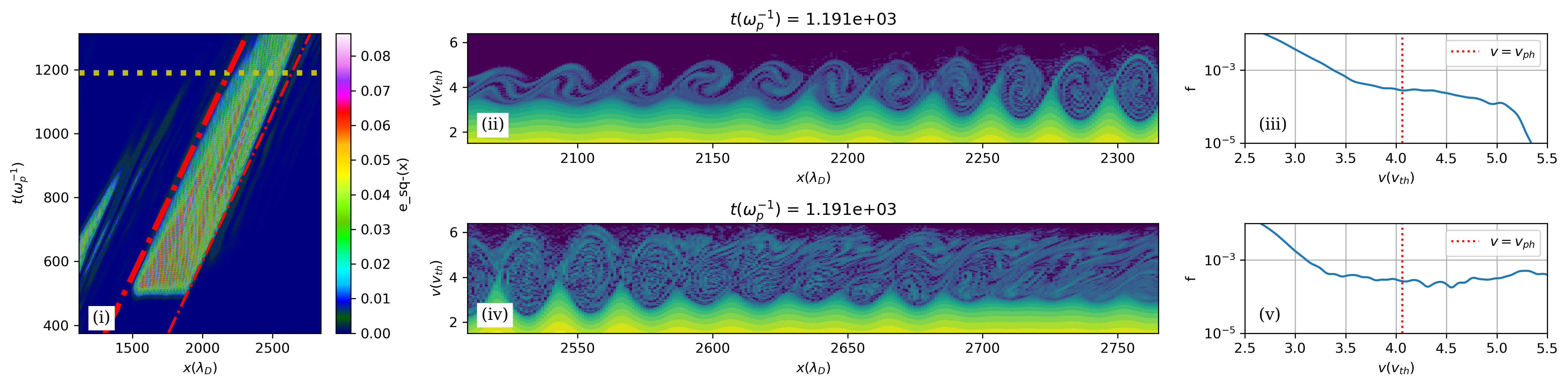
The learned functions recovered physically interpretable scalings — optimal excitation location tracks the phase velocity, frequency shifts match trapped-particle theory — all without imposing these relationships. The neural network discovered mechanisms, not just parameters.
Full details: Discovering novel physics using differentiable kinetic simulations
Application 2: Learning kinetic closures for fluid simulations
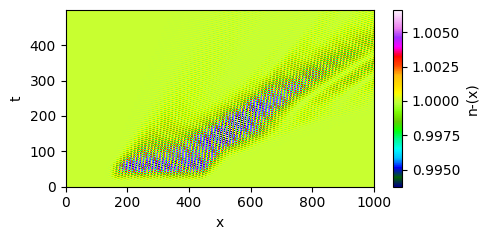
Nonlinear Landau damping introduces spatiotemporal nonlocality that no local fluid closure can capture. We introduced a hidden dynamical variable into a differentiable fluid solver, representing the resonant electron population. Its growth rate — the only unknown — was learned by a 160-parameter neural network trained through indirect supervision: comparing fluid and kinetic predictions of density mode amplitudes, with gradients backpropagated through the entire simulation.
| Vlasov simulation (truth) | Learned hidden-variable closure |
|---|---|
 |
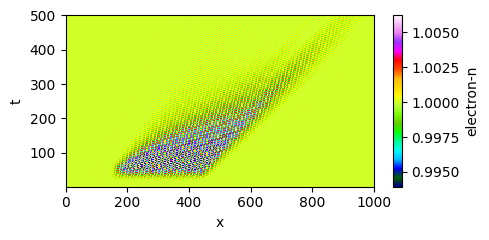 |
Trained only on single-wavelength periodic boxes, the model generalizes to wavepackets in domains 100x larger with open boundaries — reproducing etching that a local closure misses entirely. The physics encoded in the transport equation provides the generalization; the network just learns a coefficient.
Full details: Deep learned closure model for nonlinear Landau damping
Application 3: Accelerating Thomson-scattering diagnostics
Reverse-mode AD transforms Thomson-scattering analysis from a slow, serial, manual process into a fast, batched, automated one. The full diagnostic model — spectral density function, susceptibility integrals, instrumental convolution — was implemented in JAX, making it differentiable with respect to all plasma and instrumental parameters.
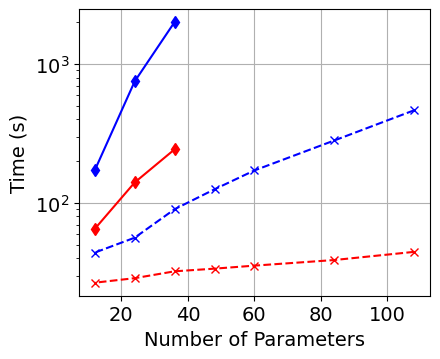
The speedup enables per-pixel analysis of entire datasets, Hessian-based uncertainty quantification at negligible additional cost, and — most importantly — fitting electron velocity distribution functions with over 256 free parameters. This transforms Thomson scattering from measuring bulk parameters into probing kinetic physics directly.
Full details: Differentiable Thomson scattering for near real-time plasma diagnostics
Application 4: Inverse design of spatiotemporal laser pulses
Discovery asks “what physics emerges from optimized inputs?” Inverse design asks the converse: “what inputs produce desired physics?” We applied gradient-based optimization to design structured laser pulses — with coupled spatial and temporal features — that achieve target far-field behavior.
The framework was applied to three problems. The most striking is generating a uniform plasma column through ionization in hydrogen gas. Purely spatial optimization reduces the loss by 0.2%. Purely temporal optimization: 0.1%. Full spatiotemporal optimization: 93%. Coupled space-time structure provides capabilities fundamentally inaccessible to either dimension alone.
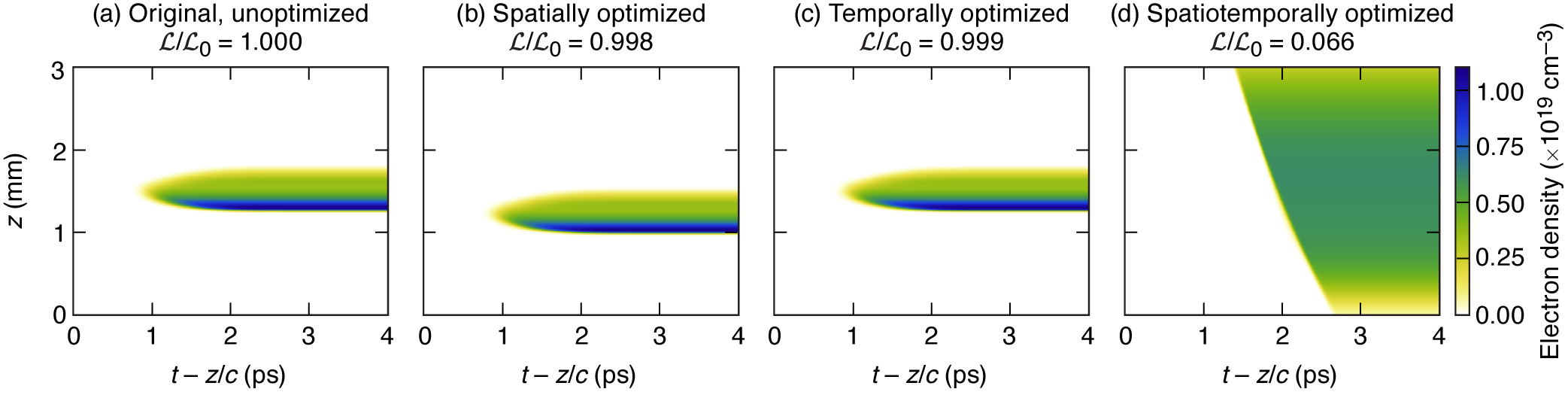
The optimized pulse exhibits complex near-field structure — radially varying central frequency, duration, and amplitude with chromatic focusing — that would never emerge from forward design. The optimization also discovered a flying-focus configuration with superluminal (1.14c) intensity peak, entirely autonomously.
Implementation across applications
All four applications use reverse-mode AD through JAX. The key enabling techniques are shared:
- Reverse-mode AD provides gradients at O(1) cost regardless of parameter count — critical for problems ranging from 10 parameters (Thomson scattering per lineout) to 1000+ (distribution function fitting, neural network weights)
- Gradient checkpointing trades compute for memory, reducing storage from O(T) to O(sqrt(T)) timesteps — essential for the long kinetic and fluid simulations
- Neural networks as function generators — the network does not replace the physics; it generates parameters for a first-principles solver, ensuring interpretability and conservation
- Physics-motivated loss functions — no labeled data needed; objectives are defined in terms of physical quantities (electrostatic energy, mode amplitudes, spectral fit residuals, target far-field profiles)
Broader implications
The same AD infrastructure that accelerates a diagnostic also discovers nonlinear wave interactions and learns multiscale closures. This is not a coincidence — all are inverse problems posed within physics-based models. As differentiable programming tools mature, combining them with symbolic regression offers a path toward automated hypothesis generation: optimization identifies candidate mechanisms, and symbolic analysis distills them into interpretable mathematical relationships.