Everything below runs on the same machinery: automatic differentiation applied to a physics solver, which turns a simulation into something you can optimize through. We argue in a recent review that this is a unifying framework for plasma physics rather than a collection of tricks — the same infrastructure carries you from fitting a diagnostic, to discovering a mechanism, to designing an experiment.
Differentiable Programming for Plasma Physics: From Diagnostics to Discovery and Design — preprint, 2026
Differentiable fusion design and diagnostics
Fusion experiments have more design knobs than anyone can scan by hand — pulse shapes, capsule geometries, driver configurations. Differentiating through the simulation turns that into an optimization problem instead of a parameter sweep.
The clearest demonstration is designing an implosion outright. Automated ICF design normally treats the radiation-hydrodynamics code as a black box, which forces gradient-free optimization and scales badly as the design space grows. Differentiating through the implosion model instead gives gradients of performance with respect to the design, so target geometry and laser pulse can be optimized together. Applied to 25 kJ OMEGA-scale direct-drive implosions, this optimizes 500-parameter laser pulses across sampled target geometries.
The result worth dwelling on is the one nobody asked for. Optimizing the Lawson parameter alone, the pulse converges on a near-isoentropic rise to peak power — visible in the lower-left panel below, where the optimized drive tracks the Nuckolls isoentropic compression curve almost exactly. That structure is something ICF designers normally impose by hand. Here nothing imposed it; gradient descent on performance arrived at the shape the theory predicts.
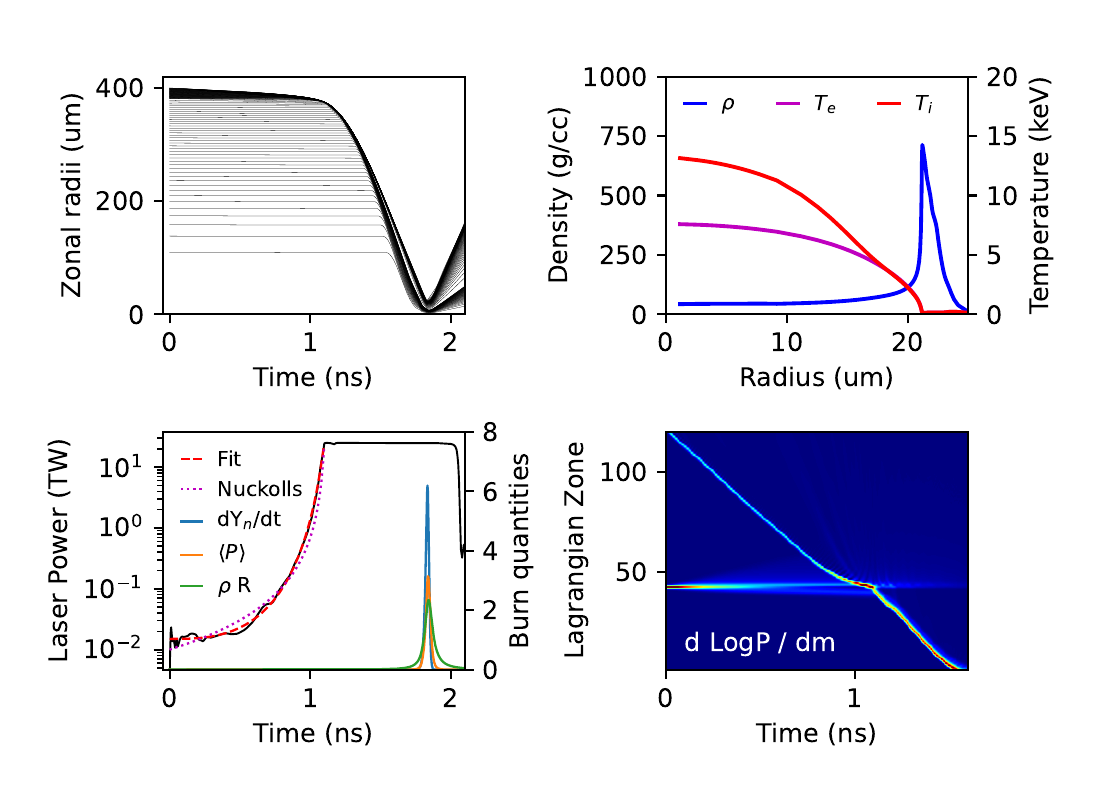
The design reaches an implosion velocity of 645 km/s at a low adiabat, and the method gets there in tens of simulations where gradient-free approaches need hundreds to thousands. Parameterizing the pulse with a neural network accelerates the search further.
The same machinery applies to suppressing laser-plasma instability, where optimizing the amplitude and phase of a broadband pulse’s spectral lines raises absolute two-plasmon-decay thresholds past the coherence-time scaling at fixed bandwidth, and to designing structured pulses whose coupled space-time behavior is inaccessible to purely spatial or temporal shaping.
Diagnostics are the same mathematics pointed at data instead of at a design. Our differentiable Thomson-scattering analysis fits O(1000) free parameters — enough to recover electron velocity distribution functions directly — at a speedup that puts it within reach of use during an experiment.
Fundamental kinetic plasma physics
Kinetic plasmas are where fluid intuition fails: trapping, Landau damping, and weak collisions produce behavior that no local closure reproduces. Gradients let us both find these mechanisms and encode them.
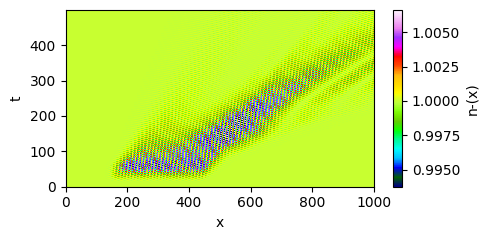
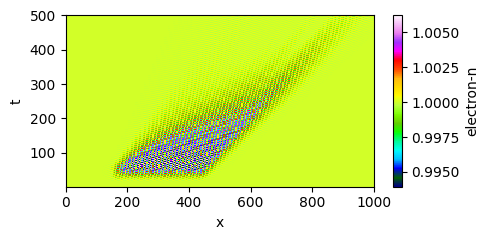
Optimizing through a Vlasov-Poisson-Fokker-Planck solver, we discovered a superadditive regime in which two interacting wavepackets sustain electrostatic energy far longer than either would alone — the optimizer found it unprompted, given only a physics-motivated objective. We then embedded a learned hidden variable in a differentiable fluid solver to produce a closure that reproduces trapping-regime physics, trained on single-wavelength boxes and generalizing to domains 100x larger.
More recently we characterized the three-phase evolution of large-amplitude, weakly collisional electron plasma waves, the velocity-space mode scalings that govern resolution requirements in Landau damping, and nonlocal closures for inverse bremsstrahlung absorption.
| Vlasov simulation (truth) | Learned hidden-variable closure |
|---|---|
 |
 |
Agentic scientific computing
This is our newest area, and it has no publications yet.
Our simulation tools are increasingly driven by agents rather than by hand: setting up runs, launching them on HPC, reading results back out of experiment tracking, and deciding what to run next. The binding constraint turns out not to be the model — it is the quality of the tools you hand it, and how much of the scientific context those tools carry. We presented what we have learned so far at the 2026 Plasma Kinetics Workshop, and our own agent setup for NERSC, MLflow, and ADEPT is public in ergodic-claude.
Our solvers are open source — see code. For the full record, see publications and talks and posters.
Selected work in depth
-
Evolution of a large-amplitude, weakly collisional electron plasma wave
Kinetic simulations show that large-amplitude electron plasma waves evolve in three distinct phases, and that the poorly understood middle phase — detrapping — is where weak collisions drive the frequency shift furthest from the linear root.
-
Discovering novel physics using differentiable kinetic simulations
We built a differentiable Vlasov-Poisson-Fokker-Planck solver and used gradient-based optimization to discover a novel superadditive effect in nonlinear plasma wavepackets relevant to inertial fusion.
-
Differentiable Thomson scattering for near real-time plasma diagnostics
We built a differentiable Thomson-scattering analysis tool using reverse-mode automatic differentiation and GPUs, achieving >140x speedup over previous methods and enabling near real-time plasma diagnostics, Hessian-based uncertainty estimation, and direct measurement of electron velocity distribution functions.
-
Differentiable programming for plasma physics
A review demonstrating that differentiable programming — automatic differentiation applied to physics solvers — provides a unifying framework for diagnostics, discovery, closure learning, and inverse design in plasma physics.
-
Deep learned closure model for nonlinear Landau damping
We embedded a machine-learned hidden variable into a differentiable fluid solver to capture nonlinear Landau damping — a kinetic effect no fluid closure had previously reproduced. Trained on single-wavelength boxes, the model generalizes to wavepacket geometries 100x larger.